
Building Broker vs Builder Explained
Understand the key differences between a building broker and a builder so you can choose the path that protects your budget.
You need both a builder and a broker. But they are not the same thing. Understanding the difference helps you navigate the home building journey with confidence.
A builder constructs homes. A broker guides you through the entire process. They work together, but serve different purposes. Getting this distinction right prevents confusion and ensures you get the support you actually need.
What Does a Builder Do?
A builder is a licensed construction professional who designs, prices and builds homes. Builders are responsible for the physical construction, quality of workmanship, timeline management and regulatory compliance.
Builder Responsibilities:
- Design homes (or work from designs you select)
- Provide fixed or cost-plus pricing for construction
- Manage construction and quality assurance
- Coordinate subcontractors and trades
- Obtain building permits and manage approvals
- Manage construction timelines
- Deliver the completed home
Builders focus on one element: building your home well. They are specialist in construction, not in finance, land sourcing or grant assessment.

What Does a Building Broker Do?
A building broker is a consultant who guides you through the entire home building journey. Brokers assess your situation, help you navigate finance, source land, connect you with builders, and support you through the entire process.
Broker Responsibilities:
- Assess your financial position and borrowing power
- Identify government grants you qualify for
- Source suitable land aligned with your goals
- Help you compare builders fairly
- Review builder contracts and protect your interests
- Coordinate finance, land, and builder timelines
- Support you through the entire build process
- Advocate for you if issues arise
Brokers focus on the big picture: ensuring all pieces of your build journey align and that you move forward with confidence.
Key Differences
Role in Your Journey
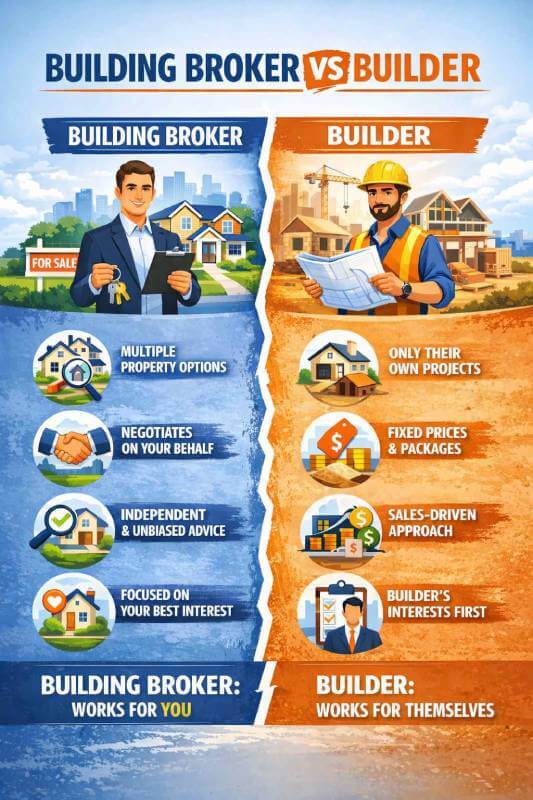
A builder does one job: builds your home. A broker does multiple jobs: assesses your position, sources options, coordinates everything and advocates for you.
Focus
A builder focuses on construction. A broker focuses on the entire journey from finance through to completion.
Expertise
A builder specialises in building homes. A broker specialises in navigating finance, land, builders, grants and coordination. These are different skillsets.
Alignment with Your Interests
A builder's interest is in completing construction profitably. A broker's interest is in ensuring your build journey works for you.
Conflict of Interest
Builders have an incentive to push higher-cost options and resist modifications that reduce their profits. Brokers have no incentive to recommend expensive options -- you benefit from their cost-saving advice.

Do You Need Both?
Yes, ideally. Here is why:
A builder alone leaves you to navigate finance, find land, compare options and coordinate everything. You become the project manager, which is overwhelming for most first-time buyers.
A broker alone cannot build your home. You still need a quality builder to do the physical construction.
The combination works well: a broker guides your decisions and coordinates the journey; a builder executes the construction.
Building Broker vs Builder: Which Path?
| Path | Description | Advantages | Disadvantages | Best For |
|---|---|---|---|---|
| Going Solo (No Broker) | You source finance, land and builders yourself. You compare options alone and manage coordination. | You avoid broker fees | You navigate complex decisions without expert guidance. You may overpay for land or finance. You may choose unsuitable builders or land. You manage all coordination yourself | Experienced property developers |
| With a Building Broker | A broker guides your decisions, sources options and coordinates the journey. You work with quality builders and have expert guidance through every stage | Expert guidance throughout the journey. Better decision-making. Cost savings that offset broker fees. Coordination and support. Lower stress | Broker fees (though these are often offset by better decisions and cost savings) | Most buyers, particularly first-time buyers and those with complex scenarios |
Types of Building Brokers
Fee-Based Brokers
Charge a fee for their guidance. You pay for their time and expertise directly. No hidden incentives.
Developer-Aligned Brokers
Recommend specific builders or developers and may earn a commission from them. Can create a conflict of interest if recommendations are driven by commissions rather than your interests.
Independent Brokers
Work independently with no developer alignment. Recommendations are based on your needs, not commissions.
The Property Plug is an independent broker. We are not aligned with specific builders or developers. Our recommendations are based on what suits your situation, not on commissions.

Builder Contracts and Protection
Whether you work with a broker or alone, understand your builder contract. Key protections include:
- Fixed pricing (or clear cost-plus terms)
- Defined timelines with milestone dates
- Progress payment schedules tied to construction stages
- Builder insurance and warranty coverage
- Dispute resolution procedures
- Your rights if the builder defaults
A broker can review your contract to ensure adequate protections. A builder will not highlight protections that limit their profits.
When Do You Need a Broker Most?
A broker is most valuable when your situation is complex:
- You are a first-time buyer
- You have a small deposit and need grant assistance
- Your income is non-traditional (FIFO, self-employed, etc.)
- You need to coordinate multiple pieces (finance, land, builder)
- You are an investor timing market entry
- You want expert guidance on complex decisions
- You need someone to advocate for you
A broker is less critical if you are an experienced property developer with strong finance and construction knowledge. Even then, an independent broker can add value.
Broker vs Builder FAQs
Potentially, but the builder's recommendation may be biased if the broker directs business to them. Independent broker recommendations are more reliable.
No. You can choose any broker. Do not assume a builder's recommendation is the best choice.
Yes, though it is more effective to work with a broker from the start. A broker can review your builder contract and provide guidance through the build.
This is rare, but if it occurs, your broker should advocate for your interests, not the builder's. Independent brokers have no reason to side with builders.
Fees vary. Some charge flat fees, others charge percentages. Effective brokers save costs that exceed their fees. Ask about fees upfront.
Often yes. If the broker can save you significant money through better decisions or cost reductions, discuss fee options.
You always have the final say. A good broker explains their reasoning and respects your decision even if you choose a different path.
Ready to Understand Your Options?
Book your free strategy call. We’ll explain how a broker can add value to your journey and discuss whether working with us makes sense for your situation.